PP FDY Technology: Principles, Evolution and Latest Trends
Polypropylene Fully Drawn Yarn (PP FDY) has emerged as a pivotal material in the global chemical fiber industry, valued for its exceptional mechanical properties, cost-effectiveness, and versatility across diverse applications. As downstream demand expands and policy-driven sustainability goals gain traction, PP FDY technology is undergoing rapid iteration, shifting toward high efficiency, intelligence, and green manufacturing. This article delves into the core principles of PP FDY technology, traces its evolutionary path, and explores the latest industry trends shaping its future.
1. Core Principles of PP FDY Technology
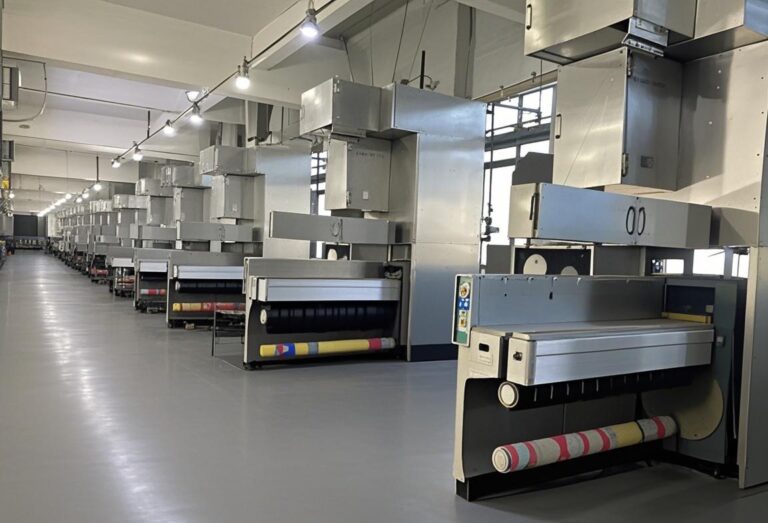
PP FDY refers to fully drawn polypropylene yarn produced through an integrated spinning-drawing-winding process, which consolidates multiple independent procedures into a continuous production line. The technological workflow comprises five key stages, each critical to determining the final fiber performance:
1.1 Raw Material Melting and Conveying
Solid polypropylene (PP) pellets are fed into a screw extrusion system, where they undergo shearing, extrusion, and heating—both from external heating devices and frictional heat generated by screw rotation. This process converts the pellets into a homogeneous molten state. The melt flow index (MFI) of the raw material is tightly controlled to ensure stable processing, as fluctuations can compromise fiber uniformity.
1.2 Melt Filtration and Spinning
The molten PP is transported to the spinning beam and uniformly distributed to spinnerets after passing through precision filtration systems (typically metal screens). These spinnerets feature hundreds of micro-orifices, whose diameter, quantity, and configuration dictate the fiber fineness and cross-sectional shape. Under pressure, the melt is extruded through these orifices to form thin filaments.
1.3 Cooling and Solidification
The high-temperature melt filaments are rapidly cooled and solidified using a side-blown air system, which delivers uniform airflow to ensure consistent fiber formation. Precise control of cooling air velocity and temperature is essential to avoid defects such as uneven crystallization, which would affect the fiber’s mechanical properties.
1.4 Drawing and Heat Setting
The as-spun fibers are drawn using multi-zone heated rollers with varying rotational speeds, creating a speed differential that stretches the fibers to enhance molecular orientation and strength. Subsequent heat setting eliminates internal stresses, improving dimensional stability and heat resistance. Modern PP FDY lines achieve fiber breaking strength of 4.5–6.0 cN/dtex and elongation at break of 20%–35%, meeting the rigorous requirements of high-end industrial textiles.
1.5 Winding and Forming
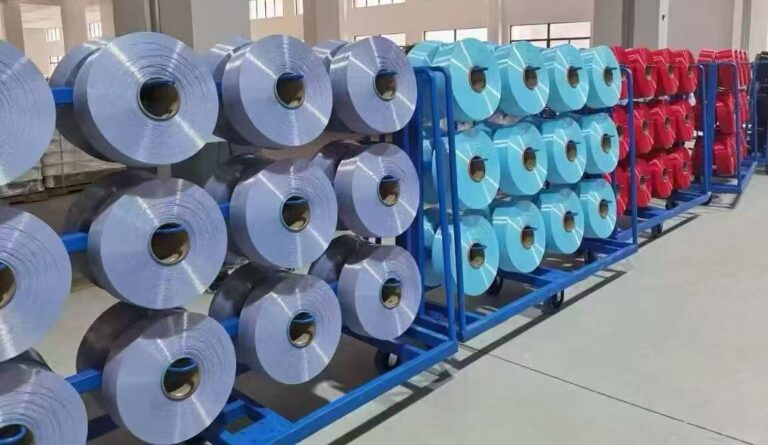
The heat-set fibers are wound into cylindrical packages by high-speed winding heads, which maintain stable tension to ensure uniform package formation and minimize waste. Advanced winding systems support line speeds of up to 4,500 meters per minute, significantly boosting production efficiency.
2. Technological Evolution of PP FDY
The development of PP FDY technology has progressed through three distinct phases, driven by the pursuit of efficiency, performance, and autonomy:
2.1 Introduction and Absorption Phase (2000–2010)
During this period, the industry relied heavily on imported equipment from international manufacturers such as Germany’s Barmag and Japan’s TMT, as domestic technology lagged. These early systems operated at speeds below 3,000 meters per minute, with single-line capacity under 50 tons per day. They also exhibited strict raw material requirements, limiting the use of domestic PP grades.
2.2 Localization and Advancement Phase (2011–2020)
Domestic equipment manufacturers, including Dalian Huayang, Yangzhou Huitong, and Wuxi Hongyuan, achieved breakthroughs in core component localization. Key advancements included heating roller temperature control precision within ±1℃, closed-loop tension feedback systems, and winding speed upgrades to 4,500 meters per minute. These improvements reduced reliance on imports and lowered production costs, while enhancing fiber dyeing uniformity (CV value below 1.5%).
2.3 Intelligence and Green Transition Phase (2021–Present)
Current technological development focuses on intelligent upgrading and low-carbon transformation. Modern PP FDY integrated lines integrate MES (Manufacturing Execution Systems), AI-driven process optimization modules, and waste heat recovery devices. These innovations have reduced energy consumption by over 15% and floor space requirements by 30% compared to traditional split-process lines.
3. Latest Trends in PP FDY Technology
Driven by policy mandates, market demand, and technological innovation, PP FDY technology is evolving toward four key directions:
3.1 Green Manufacturing and Circular Economy
Global “dual carbon” goals and policies such as China’s 14th Five-Year Plan for Industrial Green Development and the EU’s CBAM (Carbon Border Adjustment Mechanism) are forcing the industry to adopt low-carbon practices. Manufacturers are developing equipment compatible with recycled PP (rPP), enabling stable production with up to 40% rPP blending. Energy-saving technologies, including electric heating systems and waste heat recovery, have reduced unit energy consumption to 0.39 tons of standard coal per ton of fiber—below the mandatory limit of 0.48 tons set by industry standards. Additionally, closed-loop systems linking “plastic waste—recycled pellets—PP FDY—products” are gaining traction, supporting circular economy goals.
3.2 Intelligence and Digital Transformation
The integration of 5G, industrial internet, and AI is reshaping PP FDY production. Intelligent lines feature real-time monitoring of key parameters (temperature, tension, fiber diameter) and AI-driven self-optimization of process settings, reducing defect rates and improving consistency. By 2025, the penetration rate of smart manufacturing in the textile industry is expected to exceed 55%, with PP FDY equipment leading this transformation. MES systems enable end-to-end production traceability, while predictive maintenance reduces downtime and extends equipment lifespan.
3.3 High-Value-Added Product Innovation
Market demand is shifting toward high-performance PP FDY variants, including ultra-fine denier fibers, profiled cross-section fibers, and functionalized products. Ultra-fine denier PP FDY (below 0.5 dpf) is used in medical nonwovens and high-end filters, while profiled fibers (e.g., triangular, hollow) enhance moisture-wicking and thermal insulation properties for apparel and home textiles. Equipment manufacturers are developing modular designs to support quick product switching, catering to customized demand from downstream sectors such as geotextiles, automotive interiors, and medical supplies.
3.4 Policy-Driven Industrial Upgrading
Government policies are playing a pivotal role in guiding PP FDY technology development. China’s Chemical Fiber Industry Standards (2023 Edition) mandate single-line capacity of no less than 60 tons per day and mandatory carbon emission monitoring systems. Financial incentives, including green bonds, first-set equipment insurance compensation, and local renovation subsidies (up to 20% of equipment investment in Fujian Province), are accelerating the adoption of advanced technology. These policies have driven the domestic market share of high-end PP FDY equipment to 38.5%, with export growth of 31.5% year-on-year in 2023.
4. Market Outlook
The global PP FDY market is poised for robust growth, fueled by expanding downstream applications and technological innovation. From 2023 to 2030, global PP FDY output is projected to increase from 39.5 million tons to over 75 million tons, with the equipment stock rising to 320–350 units—a compound annual growth rate of 11.2%–12.5%. High-value-added variants, including rPP-compatible, ultra-fine denier, and intelligent lines, will account for over 55% of the market by 2030, up from 35% currently.
Looking ahead, PP FDY technology will continue to converge with intelligence, low-carbon manufacturing, and circular economy principles. Breakthroughs in material science and cross-industry technology integration will further expand its application scope, solidifying its position as a cornerstone of the global functional fiber industry.